

If I sell on Amazon, what type of insurance do I need in 2026 to be covered in the event of product-related problems or claims? What are Amazon’s requirements under its official policies?

If I sell on Amazon, what type of insurance do I need in 2026 to be covered in the event of product-related problems or claims? What are Amazon’s requirements under its official policies?
A product complaint may begin with a defective component, but the cost does not necessarily stop at refunding the order. If the product causes an injury or damages a customer’s property, you may receive a compensation claim and requests for documents with a short response deadline.
For bodily injury or property damage caused by a product, you need commercial liability insurance that includes product liability cover. Professional liability insurance does not automatically replace this protection.
This guide separates the marketplace requirement from financial protection and claims management. It provides guidance on:
- the appropriate type of policy for damage caused by products;
- the requirements published by Amazon;
- additional risks and European legislative changes in 2026.
What risks arise when selling products on Amazon in 2026?
An overheating charger may damage furniture. An accessory that breaks during use may injure a customer. If a demonstrable link exists between a defect and the loss, the matter may escalate from a return to a compensation claim for bodily injury or property damage.
Not every complaint is a product liability claim. A delivery enquiry, a return request or dissatisfaction with the product description may follow a different process. Refunds, returns, advertising costs and lost stock are not automatically covered by a liability policy.
Bodily injury or property damage: these are risks that a product liability policy may cover, subject to the terms and limits of the contract. It matters which product caused the loss, who manufactured it and whether the defect caused the alleged damage.
Supply chain liability: your role may vary. You may be the manufacturer, importer, distributor or seller. Keep supplier invoices, batch identification records, instructions, labels and safety documents. In a claim, this information helps establish the product’s route through the supply chain and identify the parties involved.
A well-organised file does not replace insurance. It does, however, enable you to respond more quickly to questions from the insurer or marketplace and to determine whether the complaint concerns a defect, misuse or an issue unrelated to the product.
What type of insurance covers damage caused by a product?
When selling goods, look for a commercial liability policy that includes products and completed operations liability. Insurance product names vary between markets and insurers, so check the risks listed in the policy wording rather than relying only on the policy title.
- Commercial general liability: may cover certain third-party claims for bodily injury or property damage related to the company’s activities.
- Product liability: concerns losses attributed to a product sold by your company, subject to the policy’s terms and limits.
- Completed operations: relevant cover for liability connected with products after they have been sold or delivered.
- Additional limit: an umbrella or excess policy may provide a limit above the primary policy, provided that the structure is accepted by both the marketplace and the insurer.
Product recall insurance is separate protection or an extension; it should not be assumed to be included. Notification, transport, storage or destruction costs depend on the contractual terms and the reasons for the recall.
Do not confuse this protection with professional liability insurance. Professional liability generally addresses errors or omissions in professional services. A policy for services does not automatically cover injury caused by a physical product.
What does Amazon.com’s official seller insurance policy require?
The official commercial liability insurance policy states that the rule applies to sales on Amazon.com. For that marketplace, Amazon requires insurance within 30 days after gross sales proceeds exceed USD 10,000 in one month. It may also request a policy in other circumstances.
Limit and covered risks: the minimum limit is USD 1,000,000 per occurrence and in the aggregate. The policy must cover liabilities related to the company’s operations, including products, completed operations and bodily injury. Cover must apply to all products listed in the Amazon.com store.
Policy form and deductible: the rule generally requires an occurrence-based policy. If you cannot obtain this type of policy for certain categories, Amazon advises discussing a claims-made policy with your insurer. The deductible may not exceed USD 10,000 and must be shown on the insurance certificate.
Amazon as an additional insured: the certificate must name exactly “Amazon.com Services LLC and its affiliates and assignees”. The insured company’s legal name must match the information in the seller account, subject to the exceptions in Amazon’s policy for certain single-member companies.
Insurer and documentation: the insurer must have global claims-handling capability and a financial rating of at least A- from S&P and/or AM Best, or an accepted local equivalent. The certificate must be completed and signed by an authorised representative. The insurer must notify Amazon at least 30 days before cancellation, modification or non-renewal, and the policy must not contain a special sunset clause.
Important: Amazon states that, from 2 November 2026, products in categories with enhanced safety requirements will require at least USD 1,000,000 of insurance per occurrence and in the aggregate, regardless of the sales threshold. The categories are listed on the Seller Central page concerning products with enhanced safety requirements.
How Leader Team supports Amazon sellers with insurance in 2026
Leader Team provides a liability solution for companies selling on Amazon. The dedicated Amazon seller insurance page describes the limits, territory of cover and the option to add Amazon to the policy as an additional insured.
Limit and insurer financial strength: the solution offers a USD 1,000,000 limit for damage caused by products. It is available from an insurer with an A+ rating from S&P and AM Best. These characteristics are relevant when comparing the policy with Seller Central’s minimum A- rating requirement.
Territory and additional insured: worldwide cover, including the United States and Canada, with the option to name Amazon as an additional insured.
Quotation and claims support: quotation within 48 hours and assistance from consultants and Leader Team’s in-house claims department. To obtain a quotation, information about the products sold, target markets and scale of operations will help with the risk assessment.
What complementary services can supplement Amazon seller insurance?
A product liability policy does not cover every potential loss faced by an online seller. Depending on your goods, suppliers and processes, you may separately consider protection against other types of loss.
- General liability: general liability insurance may be relevant for certain losses caused to third parties in connection with the company’s activities. Check whether product liability is included or excluded.
- Product recall: product recall insurance may cover certain recall costs if the cause and expenses are covered under the contract.
- Cyber incidents: cyber insurance for companies addresses digital risks, such as an incident affecting the company’s systems or data.
How is a claim for injury or property damage handled?
The A-to-z process for property damage and bodily injury applies to claims involving products verified as defective and sold on Amazon.com. It differs from ordinary A-to-z claims concerning delivery, product condition or returns. Amazon describes the steps on its claims process page for property damage and personal injury.
For a claim of USD 1,000 or less, Amazon may resolve the matter by granting a concession to the customer. If you have uploaded proof of insurance, Amazon states that it will not seek reimbursement from you for the concession it has granted. If it requests proof after notifying you, you have seven days to provide it. Failure to do so may result in a reimbursement request.
For claims exceeding USD 1,000, you or your insurer must engage directly with the customer. Amazon requires a response to the notification within seven days and generally expects the settlement attempt to be completed within 30 days. Complex cases or a lack of cooperation may require more time.
If Amazon resolves the claim and you disagree with its decision, you may submit an appeal within 30 days. Keep photographs, instructions, compliance documents, invoices, correspondence and any evidence relating to the use of the product. Respond promptly, even if you are still gathering documents.
Critical point: do not treat Amazon’s request like an ordinary customer message. Record the deadline in the notification, inform your insurer and confirm in writing who is handling the response. A delay may lead to Amazon intervening and seeking reimbursement, subject to its policy terms.
How does product liability for goods sold in the European Union change in 2026?
For a seller operating in Europe, legal obligations and the requirements of an Amazon store are two separate matters that must be checked independently.
The European directive on liability for defective products must be transposed into national law by 9 December 2026. The new rules apply to products placed on the market or put into service from that date. The EUR-Lex summary on product liability also describes circumstances in which importers, authorised representatives or fulfilment service providers may be liable under the conditions set out in the directive.
- Establish who manufactures, imports and distributes each product. Your company’s role may be relevant if the manufacturer is located outside the European Union.
- Retain documents identifying the product, batch, supplier and instructions provided to the buyer.
- Check whether the policy covers the territories in which you sell and includes your role in the supply chain.
Important: the European directive establishes the liability framework for defective products; it does not automatically impose an Amazon insurance limit in every country. Review the applicable law, the sale contract and the policy of the marketplace you use separately.
Assessment checklist and comparative analysis of Amazon seller insurance in 2026
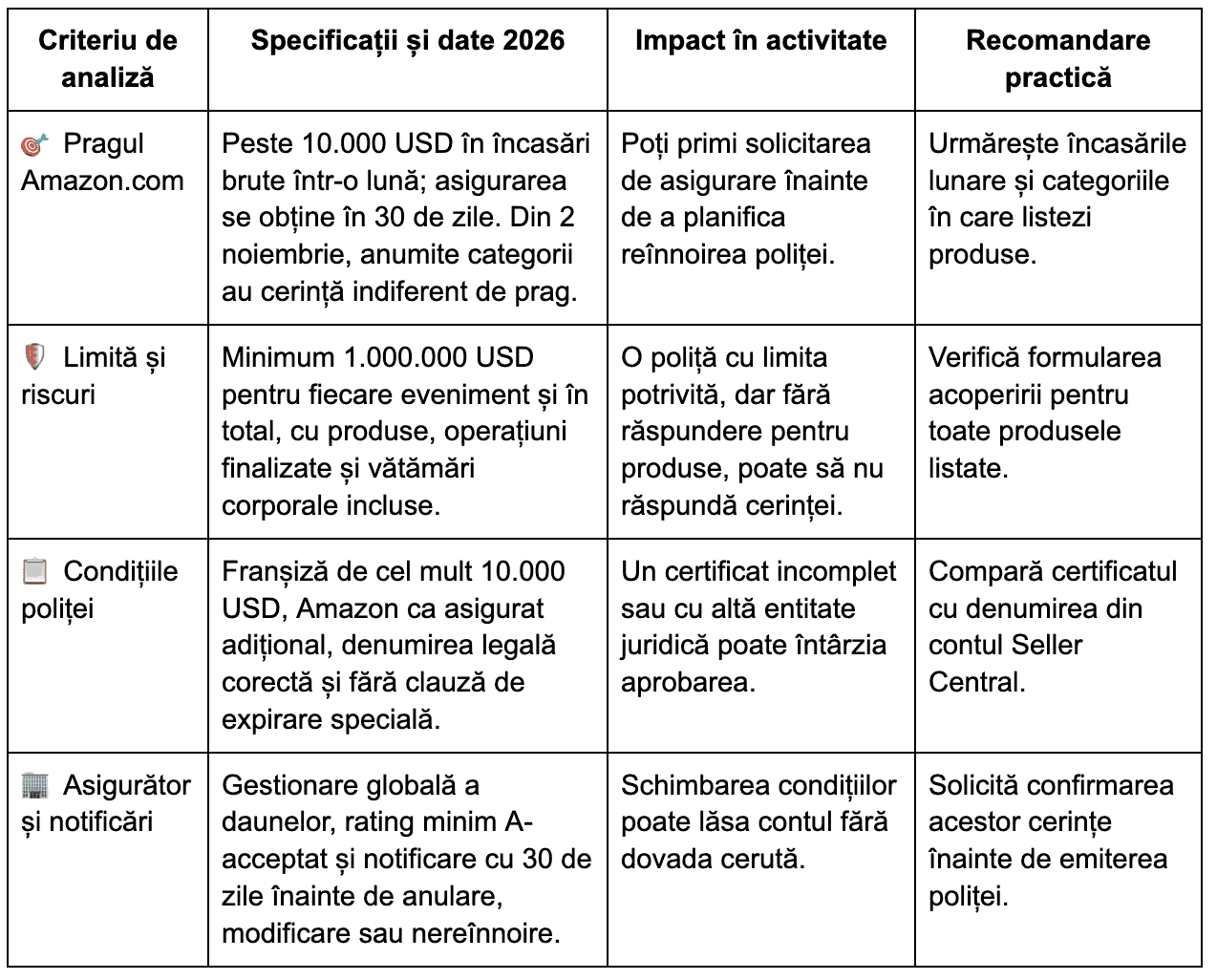 How to choose and properly manage Amazon seller insurance in 2026
Separate the marketplaces: note where you sell and which policy applies to each store. The requirements reviewed for Amazon.com should not be assumed to be identical in Germany, France or other markets. Request confirmation of the requirements for each account and country.
Check the covered risk: look explicitly for product liability, completed operations and bodily injury cover. Compare the definitions and exclusions. A policy described as commercial liability may not cover products if they are excluded or if the declared business activity does not reflect the actual sales activity.
Compare the limit with the deductible: check the per-occurrence limit and the total available aggregate, then review the deductible and how it applies. If you sell high-risk products or operate in several markets, discuss whether the required limit reflects the company’s exposure rather than merely meeting the platform’s minimum threshold.
Prepare the certificate: make sure the legal entity, additional insured and limits are stated correctly. Check the signature, policy period and notices concerning modification or cancellation. Keep the version uploaded to the account and the documents showing which products are included in the cover.
Establish a claims workflow: appoint the person responsible for checking notifications, contacting the insurer and archiving evidence. Review the policy whenever you launch new products, enter another market, change suppliers or exceed sales thresholds.
Appropriate protection for an Amazon seller begins with product liability, but it is not limited to the amount shown on the certificate. The actual cover, target marketplace, documentation and response time to a claim all matter.
If you sell through Amazon, ask your broker to compare the policy with the official requirements for each market and to explain separately what happens in the event of claims, product recalls and ordinary complaints. Leader Team can assess the available options for dedicated Amazon seller insurance.
References
- Amazon Seller Central, Commercial Liability Insurance Requirements, for sales on Amazon.com. https://sellercentral.amazon.com/help/hub/reference/external/G200386300
- Amazon Seller Central, A-to-z Claims Process for Property Damage and Personal Injury. https://sellercentral.amazon.com/help/hub/reference/external/GTY6NYZDFD5CENYH
- Amazon Seller Central, Product categories with enhanced safety listing requirements. https://sellercentral.amazon.com/help/hub/reference/external/G4RUG6EAT2ZLVSRT
- EUR-Lex, Defective products and liability. https://eur-lex.europa.eu/EN/legal-content/summary/defective-products-liability.html
Frequently asked questions about Amazon seller insurance in 2026
What type of insurance do I need if I sell products on Amazon?
For bodily injury or property damage caused by a product, look for a commercial liability policy that includes products and completed operations liability. Amazon.com accepts commercial general liability, umbrella or excess policies if they meet the Seller Central criteria. Professional liability insurance for services does not automatically replace product cover. Check the relevant marketplace, because the Amazon.com policy does not automatically establish the terms for European stores.
When does Amazon.com require commercial liability insurance?
For Amazon.com, insurance must be obtained and maintained within 30 days after gross sales proceeds exceed USD 10,000 in one month, or if Amazon requests it separately. From 2 November 2026, products in categories with enhanced safety requirements require a policy regardless of that threshold. Check the Seller Central list for your product category and monitor marketplace updates.
What policy limit does Amazon require from sellers?
Amazon.com’s policy requires a minimum of USD 1,000,000 per occurrence and in the aggregate. Cover must include liability related to products, completed operations and bodily injury. The deductible may not exceed USD 10,000 and must appear on the insurance certificate. Amazon must be named as an additional insured, and the document must match the company’s legal name in the Seller Central account.
What does Leader Team’s Amazon seller insurance provide?
Leader Team presents a solution for Amazon sellers with a USD 1,000,000 limit for damage caused by products, worldwide cover including the United States and Canada, and the option to name Amazon as an additional insured. Check the issued policy for its limits, deductible, included products and the current Seller Central criteria.
Does professional liability insurance cover a defective product?
Do not assume that a professional liability policy covers damage caused by a physical product. Professional liability generally concerns errors or omissions in the provision of professional services. For bodily injury or property damage caused by a product, confirm that separate product liability cover is in place.